Saturday, 25 June 2011

Activity in Windrush Square 30 June 2011

Hi all, and, thanks Richard

Sorry I haven't been in contact sooner on this. However, I have just got
back from my National Union conference where we were discussing the cuts
and how to fight back and protect our jobs and our services.

I am pleased to say I was able to speak at the conference in front of
delegates from across the whole country.

I talked about what is happening to Disabled people both those who are
at work and those who are not and the devastating effects the cuts are
having on us. I also spoke about Disabled People Against Cuts both here
in Lambeth and Nationally and how we are organising. I got a good round
of applause when I said we would be supporting the Teachers, College
|Lecturers etc on June 30th.

Which brings me to what is happening in Windrush Square on June 30th.

We will be gathering in the square at around 10.30am to greet the
Teachers and Lecturers who will be marching down into Brixton from their
picket lines.

There will be people from several organisations including Pensioners
groups, Childrens services, Librarians, and, ourselves.

There will be music and some speakers.

It will be an opportunity for us to demonstrate our opposition to the
cuts to the People First group from 336, the cuts to Taxicards, Freedom
passes, the Contributions policy the moves to privatise services, cuts
to Legal Aid and the attacks on our benefits.

South London Disabled People Against Cuts welcomes everyone who wants to
join in on the day and to be part of joining the whole community
together to stop the cuts.

I look forward to seeing as many of you as possible there on the day!

Regards and solidarity

Roger

Roger Lewis
South London Disabled People Against Cuts (SLDPAC)

Saturday, 4 June 2011

The ‘Protest and Survive’ Meeting


The ‘Protest and Survive’ meeting was possibly small in number; I counted 30 in all. We had some good speakers, people representing different age groups and strands of the disability community in Lambeth.

The speakers’ broached subjects ranging from how Tory-led policy on social housing was, and would in the future, discriminating against the poorest, including, of course, disabled people.

Ellen Lebethe spoke of how the cuts were hitting older people. But more importantly, she told us the importance of unity and solidarity.

Roddy Slorich presented his case from the perspective of mental health service users.

A representative of People First Lambeth told of how their funding was cut earlier in the year. She and her ex PFL workmates were finding it very difficult to find work. But, she was still willing to fight.

A motion was moved by Roger Lewis, seconded, and agreed by the meeting to resolve:

  1. To convene a South London Disabled People Against the Cuts campaigning group and affiliate to the national Disabled People Against the Cuts network. 
  2. To agree to support local trade unions and others taking industrial action on 30th June in defence of their jobs and services, particularly in Education, and to use the day of protest to highlight the effects the government cuts are having on Disabled people generally.
  3. To hold an event in Windrush Square in Brixton on June 30th alongside Childrens Adventure Play services and others to support the services that have already been cut locally or which are in danger of being cut, including the cut in funding to People First Lambeth, a voluntary group for people with learning difficulties.
  4. To support similar activities in other boroughs in South London in conjunction with any activities being organised through local anti cuts organisations.

A slightly discordant note was struck towards the end of the meeting when two people criticised the cuts movement for not achieving anything and leaving things too late, a reference to the three poorly attended consultations on Care, TaxiCard, and the Freedom Pass.

However, these criticisms were countered as speakers who followed gave a more positive view of successes such as Birmingham Council being defeated; others spoke of the recently successful marches, the Lambeth Assembly, etc.

Tuesday, 31 May 2011

Declaration By Lambeth SOS

This declaration was agreed at our Peoples Assembly on May 21 2011. Please bring amendments to our next assembly.

The Lambeth ‘People’s Assembly’, 21 May 2011


The Lambeth ‘People’s Assembly’ showed that there is a lot of controlled anger in Lambeth ready to be harnessed into action/s. As a 'people's assembly' it lived up to its title. There was a wide cross-section of people and groups from, mainly, across the borough. 

John McDonnell gave a contemporary take on the deficit and how this government was mismanaging the recovery. While Ted Knight made a very good contribution from a historical perspective.

Kingsley Abrams received a rapturous welcome when introduced as the only Labour Councillor to make a stand against the cuts. Councillor Abrams was swiftly punished by the Labour Group in Lambeth and suspended for three months, ostensibly for comments alleged to have been made; but, in reality for breaking Party discipline.

Councillor Abrams
Ruth Cashman, a librarian and trade unionist working in Lambeth, drew a picture of the range of cuts across the borough going on to explain the wider implications surrounding the closure of libraries, the elimination of park rangers and the sacking of park rangers.

Anita Wright spoke passionately on education. She also flagged up the importance of the Lambeth Trades Council within the SOS and across the fight against the cuts.

I chaired the disability workshop. Sadly, we didn't have time to cover all 17 or 18 areas of cuts; and, by agreement we focused on how we as a group could pull together and fight against and assist one and other on benefits' cuts.

Future events for disabled people in Lambeth include the Lambeth Pan-Disability Forum’s ‘Protest and Survive’ meeting. This is an open meeting for disabled people in Lambeth, and interested parties, to meet and discuss how we as a group can resist the Tory cuts. It was also agreed that we fully support whatever action was taking place on 30th June.


Seán McGovern speaking
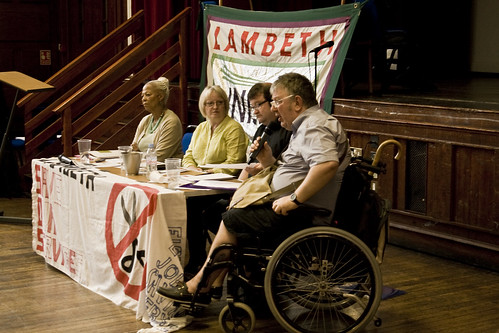
Left to right seated at table
Ellen Lebethe, Anita Wright and Richard Farnos
Ellen Lebethe, Lambeth SOS and Lambeth Pensioners Action Group, gave a grave account of the services elderly people in the Borough were losing; however, this gloomy news was tempered by Ellen’s indomitable fighting-back attitude.  

Queers Against the Cuts spokesperson, Richard Farnos, told how the LGBT community was disproportionately dependent on resources, including health. Communities should not be divided to “fight for the crumbs from the table,” he said.

The assembly was encouraging. There is a real passion out there for action. Hopefully, future assemblies will attract more people; hopefully we can get across to those thousands of people who think they're not political, yet if the surface were scratched deep enough their political soul would be bared.

Monday, 30 May 2011

Lambeth Pan Disability Forum Thursday 9 June


Hello Everyone

The Lambeth Pan-Disability Forum will be meeting next on Thursday 9 June between 2 and 4 pm. Our meeting will take place, as usual, on the 1st Floor of 336 Brixton Road, SW9 7AA (the Lambeth Accord building).

We'll be discussing issues around the cuts as well as the Lambeth Country Show. So, please come along and have your say.

Thanks

Seán 


Friday, 27 May 2011

Direct Action, yes. Reckless behaviour, no!

Was the driver of the bus aware of two people handcuffed to the rear of his vehicle? Can anyone imagine the horror of two protestors being dragged behind a bus; because, I doubt the driver could see the wheelies below window level and in effect in a ‘blind’ position, as they don’t have mirrors there.


While I applaud direct action; and fully agree with the right to a fully integrated and accessible transport system, I don’t agree with what could result in reckless behaviour.

As a trade unionist in a union that organises bus drivers I’ve had some approach me with their concerns on this very issue. No bus driver would drive off knowing there were people attached to his or her bus. And, the ones I spoke to feared that one day someone may carry out this form of protest without their knowing; and, they are terrified of the consequences.

So, may I suggest when you are carrying out this kind of action, please, let the driver know. It isn’t fair to put other workers on the spot like this. 

Thursday, 26 May 2011

Oh, My God!

While chairing the TUC Disability Conference this morning one of the staff quietly spoke to me on my use of offensive language. As you might imagine I was mortified and began wracking my brain(s) as to what I’d said to offend someone, or people.

Probably blushing, I asked the official what exactly I’d said that had excited the complaint. “You said, ‘for God’s sake’” she replied grinning broadly. Of course, relieved, I laughed explaining that as a Catholic atheist some vestiges of my formative years of indoctrination had, sadly, stuck with me.


This conversation took place off mike. However, I was a little disconcerted not wanting a protracted off-agenda debate to take place; and asked whether I should apologise. ‘No’, was the response. Just as well really, for I may have apologised by saying “Good Lord. Did I really say that? I’m very sorry.”

This post isn’t an attempt to make light of the fact that language can offend and perceive to be offensive. Had I used ‘thank Christ for that’ or used the term ‘Jesus, Mary, and Joseph’, which I often do when expressing my sadness and anger at some act of injustice or another, then fair enough; though, these were the Irish Catholic mild oaths with which I grew up.

They weren’t spoken in order to offend, but rather as an expression of exasperation or even sadness of a given event or happening.

As far as I recall on the issue of ‘disability language’ the only word of contention that I recall from the two-day conference was ‘vulnerable’. Although it was used on several occasions the context tended to be in and around two of the guest sessions, one on disability hate crime and the other was the BlackTriangle FaceBook social networking site.

Language can be a tricky tool; and, in the wrong hands quite dangerous. However, we need to be careful how we get our message across to other people. When someone uses explicitly offensive or hurtful language they need to be pulled up straight away and told they’re out of order.

Tell me, what we do when people use language, which to all intent and purpose is inoffensive, yet different groups within the disability ‘community’ find offensive. An example I’ve come across is ‘disabled people’ versus ‘people with disabilities’ (phrases that I interchange in speech). People have told me off for using ‘vision impaired’ instead of ‘visual impaired’ – I’ve use the former ever since a blind friend of mine objected to the latter on the basis that he regarded ‘visually impaired’ suggested he was ugly; and, he is of the opinion that ‘vision impaired’ is a more accurate description.

Recently, while taking part in a breaking down barriers education course another of the class members complained about the use of politically incorrect language and terminology. Considering we were all disabled and activists, the protestations seemed inappropriate. When challenged all she could come up with was the use of ‘disabled people’ instead of, in her school of thought, ‘people with disabilities’.

At this point I told the tutor that if we’re going to have every single thing we say dissected and politicised that I’d be off. Who wants to take part in a course where one person attempts to gag the majority on what are quite frankly issues of personal preference. Yes, there is a fine line between proper and improper language. And, where it is patently obvious that someone is being offensive, especially in a group of disabled people, in my experience, they’ll be brought to book in double quick time.

As things are with us now, we need, more than ever before, greater engagement with other groups of people under attack by this vicious Tory regime. Whatever alliances we forge must be on equal terms. And for this to happen we’re going to have to educate many people, especially in language and phraseology. My fear is that if we become overly proscriptive with people who wish to join forces with us, we could be in danger of, not so much alienating ourselves, but more putting others on the defensive, scared to say things in case they inadvertently ‘offend’.

So, going back to the ‘god’ expletive; was I the sinner or sinned against?